Per-Surface Tooth Charting Explained: Mesial, Occlusal, Distal & More
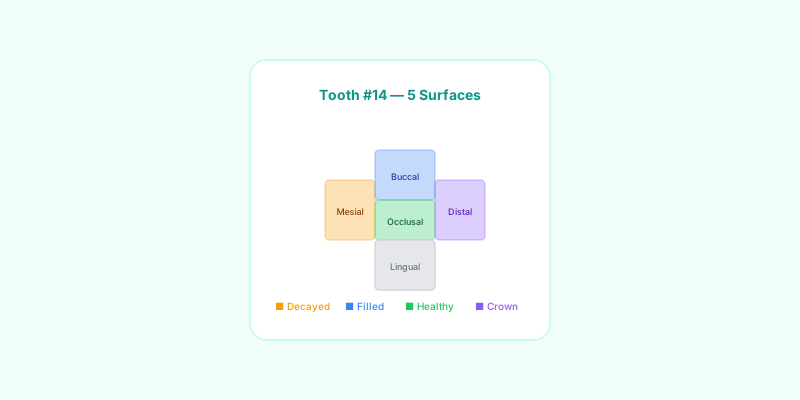
Dental charting at the surface level is essential for accurate diagnosis and treatment planning. Each tooth has five distinct surfaces, and conditions can affect one surface while leaving others healthy.
The Mesial surface faces toward the midline of the dental arch. It's the side of the tooth that faces the tooth in front of it. Mesial cavities are among the most common, especially in molars where food tends to get trapped.
The Distal surface is opposite to mesial, facing away from the midline. Together, mesial and distal surfaces form the interproximal area where flossing is critical for preventing decay.
The Occlusal surface is the biting or chewing surface of premolars and molars. This is where you'll find fissures and grooves that are susceptible to decay. For anterior teeth, this is called the incisal edge.
The Buccal surface faces the cheek (for posterior teeth) or the lip (for anterior teeth, where it's called labial). The Lingual surface faces the tongue. These surfaces are less prone to decay but important for tracking restorations and cosmetic treatments.
In digital charting systems, each surface can be independently color-coded. A tooth might show a blue (filled) mesial surface, a yellow (decayed) occlusal surface, and healthy (white) remaining surfaces. This granular view provides far more clinical information than a whole-tooth condition marker.
The grid view in modern dental software displays all five surfaces in a compact visual format, making it easy to scan an entire mouth and identify areas requiring attention at a glance.
About the software in this article. Devign Dentistry, a cloud dental practice management system built by Devign LLC, charts all five surfaces (mesial, occlusal, distal, buccal and lingual) across 32 teeth in FDI numbering. Each clinic defines its own condition labels and colors, every change is timestamped, and the same chart can be read as an arch view or as the surface-by-surface grid described above. Devign Dentistry costs $29 per clinic per month with all users included, and has a 30-day free trial.
Ready to modernize your dental practice?
Experience all these features firsthand.
Start 30-Day Free Trial